The history of tabletop gaming includes a constant tension between rules and narrative. The whole hobby takes place somewhere between rules-free narrative (playing make-believe) and narrative-free rules (the instruction manual for your slow cooker). I’d bet money that every TTRPG you can think of is some form of “a system by which we frame imaginary events”. That framework is necessary. Even freeform solo-journaling games have some rules or limitations to guide what happens. Without some standardization around decision-making or a character’s capabilities or generating events or what have you, we’re not playing a game. We’re writing a novel (which is fine, and I do that too, it’s just not what I’m here for).
And yet I keep seeing this refrain that rules are bad and narrative is good. “Rules-light” is a selling point; “rules-heavy” is a warning. Games you can pick up in five minutes are good; games with tons of content are bad. Logically, we know there’s space for games all across the rules/narrative spectrum and there’s something for any kind of player, but If I tell you a game “even has rules for how long it takes to build a bespoke ladder”, you probably squirm in your seat a little.
Heck, I do it here. Law 0 could be phrased as “don’t let the rules get in the way of the fun”. This is what the Rule of Cool is. We bake a derision for rules into the standard language of TTRPGs. There’s a slew of advice out there, from mediocre to brilliant, about how to toss out the rules when they don’t fit the game you want. It’s a perfectly valid way to go about things. You as a GM or player probably have some go-to methods of your own for adding narrative to your game by setting aside the rules.
But is it possible to do the opposite, adding rules to your game by setting aside the narrative? Even if it is possible, is it wise, and even if it is wise, is it easy? How can you do it?
Yes, to every question.
…except “how”, I guess.
The Case for More Rules
At its most basic, a rule is the absence of an abstraction. We could say a fighter is “strong”; that’s the abstraction. But is he strong enough to lift a manhole cover, or break a pool cue over his knee? How does he compare to the barbarian who is also “strong?”. When questions like this arise, we go to some rule. The rule could be static, like knowing the fighter has a Strength score of 16 or three dots in his Power skill, or it could be dynamic, like having both characters roll a die and saying that the higher role indicates higher strength in this specific instance. Different games handle it in different ways. The point is that they do handle it.
In the same way, an abstraction is the absence of a rule. If a system does not handle some information or circumstance, if it has no rules for how something should work, it trusts the players to form an abstraction for it. A fireball explodes in a 20-ft. radius. That’s a rule. How hot is it? The rules don’t care, beyond that it ignites flammable objects and deals 8d6 fire damage. The color of the fire, the shape of its plumes, the sound it makes, this is all left to the players to picture as best befits their game.
We do know that fireball with a higher-level spell slot deals more damage. We don’t know why. One might assume that it means the fire is hotter, so logically it should ignite things with a higher flash point, but that’s not explicitly in the rules. We only have that it deals X damage, and objects resist Y damage, and maybe certain things are more or less resistant to fire in particular (all else equal, paper walls burn more readily than stone walls). We don’t even know what a “flammable object” is because there’s no exhaustive list for it. A player wants to ignite something, they try to do it with a fireball of some level, and the DM has to decide whether and how that works. Once the decision occurs, it serves as a precedent, effectively a house rule that clarifies a space where a rule did not previously exist. It’s removing an abstraction, thus adding a rule.
Not all DM calls are removing abstractions to create rules, but it’s certainly not none. That’s part of a DM’s job. Every system has ambiguities. Accidental ambiguities, like when two rules conflict, are fairly rare. Intentional ambiguities via omission are more common. Much of that ambiguous space is where story decisions occur. The sailor background gives a character certain ability boosts and proficiencies, but it doesn’t give different bonuses based on whether she was a navy grunt or a pirate captain or a deep-sea crab fisher or a shipwreck salvager. You, the player, decide the specifics and how they apply to the rules (and vice versa). Sometimes a situation occurs where a DM has to give mechanical effects to this ambiguous space, like if a player requests a bonus when interacting with fellow pirates even though the background rules don’t explicitly grant it. I’d even say that’s desirable. Rules and abstraction should work together. It’s why we play games that use both. Even a one-time “yeah, you can have advantage on this” is a rule, and we encourage that sort of character-based decision-making. Clearly, adding rules is not, in and of itself, bad.
When and How to Add Rules
This is a topic with no right answer. (There are, however, at least two wrong answers: “always” and “never”.) It depends on the sort of game you and your fellow players want. It might be easier to look at the types of rules you can add and whether you feel there’s value in a given sort of additional specificity. I see three ways to add rules to a system:
Decision Making
You want something to determine the results of an action. Is the guard facing the door or away from it? Is there a buyer for a magic sword the party doesn’t need? Any number of situations in a session can come down to simple dumb luck, and any method you choose to settle those ambiguities is a form of adding rules.
The simplest method is flipping a coin: heads, the thing you want happens, tails, it does not. Rolling a die gives you a more granular set of results; a high roll indicates a distracted guard or an enthusiastic buyer, while a middling roll suggests a guard facing you but tying his shoes or a buyer who wants the sword but not for the price you expect. It also gives you the opportunity for a critical success or failure, which is where some of the most fun D&D stories happen. In my games I frequently ask players for a “luck check”, a simple d20 roll to see whether events in the universe at large align with the party’s interests. In the Delve Campaign one character even got an item that granted a +1 to luck checks. Things just seem to go right for Greg more than for other people.

I could not find the original author of this; my best guess went to a deleted Twitter post. If you know the source, give me a ring.
As a less simulationist option, base the decision on some related check that normally doesn’t apply. Maybe Intelligence (Stealth) will tell the player when they can expect a guard’s patrol to point them in a convenient direction, or Charisma (Performance) will gather enough onlookers that one of them must be a potential buyer. Neither of these is an explicit intention of the skill, but they both make tangential sense. One thing I’ve done is letting players make declarations, Fate-style, based on their rolls. The players ask about the people in the tavern, and I have them roll Wisdom (Insight) or (Perception). Then I have them tell me who they see. If they rolled well, yes, they accurately read the room and the people they created do exist, in broad strokes. If they rolled poorly, they misunderstood something (what they thought was a drow is actually an elf brooding in a shadow, and greeting her with “Hail Lolth” is liable to start a fight) or created their own problem (yes, there is a cute guy at the bar, but he’s a member of the town guard, which complicates most of the party’s less-than-legal intentions). It makes no narrative sense—the ability to see things from far away should not affect which people came to this bar to drink—but it uses a mechanic to remove the abstraction of “some people are in the room, I guess” and it rewards the players whose characters excel at the check in question.
Expanding the Depth of Rules
When you think of expansion (or supplemental) rules, you probably thinking of rules that increase a system’s breadth, allowing you to do more things. More fighting styles, more backgrounds, more spells, more monsters, all of these increase the number of options available to players and DMs. Usually when you hear about system bloat, this is what people mean, as the number of possible options balloons over time in systems like D&D or Pathfinder that are not bound to an established, complete set of rules. That’s not what I’m talking about here.
Rather, I mean expansions that increase a system’s depth, allowing you to do things more. These rules drill down into something that is normally abstracted, obfuscated, or ignored entirely. Sometimes they affect the base rules and sometimes they don’t. In many cases they overlap with breadth rules, like trap- or spell-creation rules that give you more granularity in trapmaking or spell design (depth) which lets you create more kinds of traps and spells (breadth).
 Once you start looking for them, there are a startling amount of depth rules out there. Consider Tasha’s Cauldron of Everything (because I don’t have any 5.5E expansion books). On the right is the table of contents, color-coded in orange for breadth rules and blue for depth rules*. It might look like the book is overwhelmingly breadth rules, but that’s mostly about how tables of contents work. The actual space devoted to breadth rules is 110 pages (give or take) while depth rules get 72 split across various topics: party patrons, assistant characters, magical terrain, and puzzles. None of these is required to make a game go, and you can handle all of them with minimal rolling or rules. But if you want specific information about what boons a patron can grant for what favors, or about how to create an apprentice or guest character, depth-focused expansion rules can help.
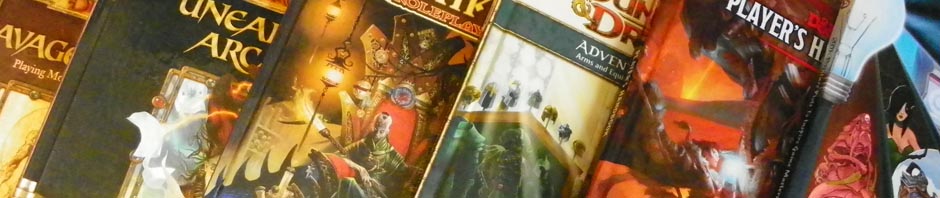
Depth-focused expansions are some of my favorite D&D books. I regularly go back to Savage Species (playing monstrous PCs), the Stronghold Builder’s Guidebook (building fortresses, lairs, sanctums, and other bases), and Weapons of Legacy (equipment that grows with characters) for ideas in my current campaigns. You can build characters, quests, or whole campaigns by diving into these expansive, optional rules and seeing where they take you. But, even better, you can also not. It’s not like hit point or spell slots where they’re so integral to the system that removing those rules forces you to add a new set of rules to fill the gap. Take some things, abandon the rest, and use what you’ve found to play the game with the depth with need in the places you want.
Using a Different System
All systems have some kind of focus. D&D’s focus is “high-fantasy adventure, especially grid-based combat”. The rules may have information about other things in limited doses, but for the most part it’s right there in the name: enter dungeons, slay dragons. (The irony of 4E, which was lambasted by players specifically because it admitted its focus instead of pretending otherwise like 5E, is not lost on me.) While there are expansion rules to cover additional topics, sometimes you want a system specifically designed for the topic at hand. There are other games that do the thing you want, but they’re not D&D, and you don’t want to jettison everything you like about D&D to try them.
So don’t. Play both.
This is not “play a better system instead, idiot” advice. As a D&D player I get enough of that, and only some of it is warranted. This is “play a better system also” advice. You can steal the bits you like from another system and integrate them into D&D. I like Fate’s aspect system, where a player can “tag” an aspect to gain a bonus on a check or a GM can nudge a character to do something unwise but narratively appropriate. D&D doesn’t have that, but it does have heroic inspiration, so I merged them together. Players picked three aspects for their character and got three inspiration points. They could use an inspiration point to gain advantage on a d20 roll appropriate to that aspect. I could also credit a point to inflict disadvantage on an appropriate roll or bribe them to act in-character but to their detriment. I didn’t have to come up with a whole new system, just tweak a few things so I got what I wanted from each.
You can pull in anything from any system in any format. I used Microscope to build the timeline for Faith. I used elements from idle games in Under the Stars. I used Minecraft for a boss fight in a Zelda campaign. You can use Monsterhearts to guide messy interactions between messy characters. You can use a narrative journaling game to build a backstory or legend for a major NPC. You can use board games to build your world, like playing Ticket to Ride to set up your world’s rails system or Pandemic to track the flow of multiple plagues or conquering hordes. You can play actual poker for an in-game gambling hall. The only limit on what you can use is what you and the players can tolerate.
The point is to get something that supplements your game by covering a space the current rules don’t. Because the world-building rules in D&D are so deliberately limited, the opportunities using other games to create or handle your setting may be obvious. It’s a little tricker with mid-session subsystems. Usually you don’t want these extra rules to take over the game; if you did, you’d be playing the other system instead and using D&D as the supplement. Rules-light systems like Fate’s aspects can work as common game elements. For major, all-encompassing shifts, you probably want them as rare or one-off set pieces. Red November is a good game for a session where the players are trying to survive in a derelict submarine, but if you’re going to build a whole campaign around it, you really want something designed for that level of scrutiny.
It’s Your Game
Obviously, nothing listed above is a strict recommendation. I would even hesitate to call it advice. They’re options, intended to present a list of possibilities that may not be obvious in a hobby where “rules-heavy” is a dirty word. Some are easier to work into your game than others, and that’s fine. The most important thing is to know why you’re adding a rule and where to stop (I might do a separate, shorter post about that). Once you’ve figured out what you want to play and you have buy-in from your players, do it. Nothing here is too sacred to deter you from playing the game you want to play.
Clearly I have a lot of ideas about ways to supplement or expand the existing rules. Some of these ideas are terrible. Some are great, but mostly in that they fix existing rules that are already terrible themselves (like words of power). If you’ve pulled any other system into D&D, or vice-versa, I’d love to hear about it. Ideally you’ll give me an idea that will make my Pokemon campaign concept work.
* — With a small gap for Session Zero, which is advice rather than rules, and it’s also a great idea gee whom do you think came up with it.