One thing I’ve been trying to do in Faith—with mercurial success—is properly foreshadow enemies. Successful fighting anime and manga tend to introduce a villain, let them run roughshod for a bit to establish stakes, and eventually let the heroes beat them after a struggle. That first step is key in setting the stage for the rest of it, because the villain’s initial actions on-screen generally decide what the viewers will think about a villain going forward. When Vegita and Nappa landed on Earth and immediately blew up a city, you knew they were going to be a threat an order of magnitude above any previous enemy. It was quick, thorough, and effective.
D&D has a slightly harder time with this, because its typical means of storytelling is “this is what you, the characters, experience with your senses”. It doesn’t have a way for the camera to cut elsewhere for a scene unless the DM starts narrating it to the players, and reading a whole script with no opportunity for interaction tends to make half the table nod off. Instead, DMs are encouraged to seed information about villains into the narrative before their first proper appearance, “introducing” them via word of mouth and examples and the experiences of NPCs without putting them in the same room as the party just yet. Sometimes the buildup is lackluster. Sometimes it’s decidedly not.
Let me tell you about the warden of the Iron Prison.
The end of The Great Tower of Oldechi had the players traversing ever-stranger demiplanes. The penultimate section of the tower had the players interacting with the same city at several points in history hundreds of years apart, changed by their actions in each era. To escalate from that I started the final section by putting them in a dream place, with dream physics and reality warping and everything, and when they leveled up, they awoke and found themselves separated in a campus-sized prison. Think of it like Arkham City, but with twice the land area and several more floors of habitable height. Each character broke out via his or her own devices. Some tried to sneak around but others started riots, intending to escape under cover of chaos. And the more noise the players made and the more guards they fought, the more people talked about the warden.
From the second the players landed in this plane, I was setting up the warden as a problem. Prisoners whispered about him, worried speaking his title might somehow reach his ears. Guards used him as a threat, warning their enemies that the warden might arrive at any time. Even officers avoided his notice, preferring to use him as a last resort, saying things like “two hundred prisoners have escaped and they’re occupying a wing of the prison, but this probably still isn’t a big enough deal to call in the warden.” Rather than think of him as a boss to fight, the NPCs—and thus the players—treated him as a hazard to be avoided, an unbeatable force like a thunderstorm or old age or the palace guards from Ocarina of Time. That’s exactly what I wanted, and when they finally decided to bust down the front door and escape over the long, exposed bridge to freedom, they knew he was going to show up whether they liked it or not.
As I discussed many a year ago, a boss has to be more than just great numbers. The warden needed something that made him interesting, so he got an aura:
Field of Oppression ✦ Aura 20
Any creature who enters or starts their turn within the aura is subject to the following attack:
Attack: Close burst 20 (one creature); +33 vs. Will
Hit: The target is knocked prone (save ends).
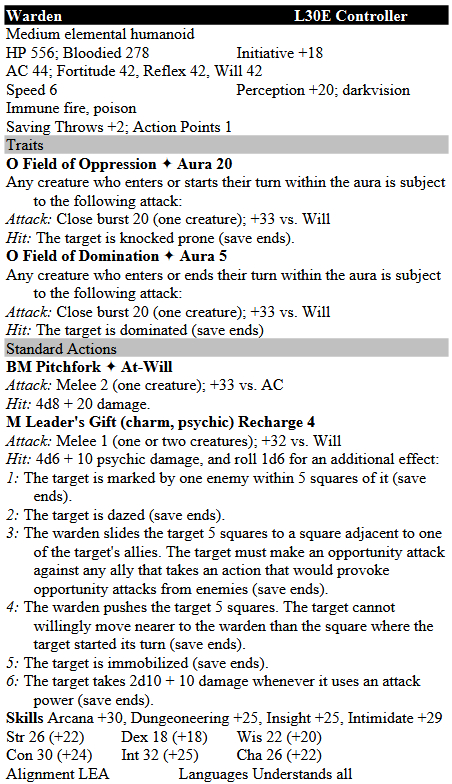
The warden’s full stat block, in case you want to see the abilities the players never did.
But we were also nearly a hundred sessions into a campaign with escalating difficulty, so the warden had another ability that was objectively unfair:
Field of Domination ✦ Aura 5
Any creature who enters or ends their turn within the aura is subject to the following attack:
Attack: Close burst 20 (one creature); +33 vs. Will
Hit: The target is dominated (save ends).
I had no idea how the players were going to deal with this aura, and I didn’t see that as a problem. My DMing style assumes that at sufficiently high levels players can handle almost literally anything. This is perhaps one reason I have so few high-level campaigns, but the few I have tend to be bonkers.
My point is that the warden’s crunch was as terrifying as his fluff. The party’s goal during the escape was to move as fast as possible so the warden didn’t even show, and their enemies’ goal was to stall them until he did. The party used all their speed tech and their high-damage moves and their consumable powers to get away from the prison and kill everything in their path, and the enemies used difficult terrain and grabs and creatures with tons of hit points and anything my toolset had to keep them still. Bit by bit the players made headway, always watching the clock, counting down the minutes until the session ended and they thought they’d be safe.
About a hundred yards from the prison gates and salvation, the warden finally showed up.
And the party’s controller, who had dealt with his aura before and avoided direct combat as much as possible, oozed up to him and hit him with the biggest teleport power he had. He hit the warden, the warden failed his saving throw, and the character teleported the warden over the edge of the bridge into the lava below. He then turned around, shouting “That won’t hold him!”, and the party booked it through the gate.
I don’t think the warden took a combat action (you’ve heard me say this before, and yes, that was the same campaign, but with a different set of characters). At best he managed a single attack before he lost a save-or-die roll. He didn’t get to do any of the things I had foreshadowed and his most powerful ability never came into play. All told, he was on-camera for about three seconds before the players finished him.
And yet! Literally without lifting a finger he became the combat the players dreaded, solely based on word of mouth and one absurd interaction with a character trying to wall-clip his way to the end of the dungeon. The narrative built to the boss more effectively than any combat. If I had brought the warden out earlier, perhaps to flatten a single player or an NPC, it introduced the possibility that the party would find a way to deal with him or a weakness they could exploit. “If it bleeds, we can kill it,” more or less. By keeping the warden in the wings until the climactic moment, there was no way for him to bleed. The players had to assume he was capable of anything and everything, including but not limited to total immunity to combat damage. If I had told them “the warden’s level is ten higher than yours”, it might cause fear; telling them nothing at all, except the results of his actions as witnessed by NPCs, caused dread, and that’s much more effective.
Conversely, many years later in Faith I had (and still have) several antagonistic NPCs designed to strike fear into the players via sheer numerical supremacy. In season 2 a single PC managed to slay one of those NPCs and meaningfully threaten another, without backup from the rest of the party, within the same session. The moment they became something that could be hit, they became something that could be beaten, and any trepidation shifted from “what if I can’t win?” to “what if the dice prevent me from winning?”, which isn’t nearly as interesting.
The trick is to remember that pacing is fractal. Earlier I mentioned three rough steps to a villain’s arc: introduction, running roughshod, and getting punched. That’s a setup, a follow-through, and a payoff. But each step can also follow the same pattern: you set up a villain by mentioning him, then follow through as the players witness the villain’s reach or the results of his actions, then give the payoff by letting him finally show up. That all just the introduction, broken down into a small arc. Even if that payoff results in the villain getting tossed into lava, you’ve still gone through a full pacing cycle, and the result is far more satisfying than saying “here is a climactic boss encounter, whoops, you bull-rushed him off a tower”.
Which I have also done.