Campaign Report – Zelda Maps 2

The Zelda campaign ended during August. Normally I’d do a postmortem of sorts to explain what the campaign was, what went right, what went wrong, and where we go from here. But I don’t think I can compress the lessons from this campaign into a single post, and there’s a lot to talk about besides what worked and what didn’t. Instead I’m splitting the normal postmortem into a few posts, each of which covers one of the things that made this campaign “Zelda-y”.

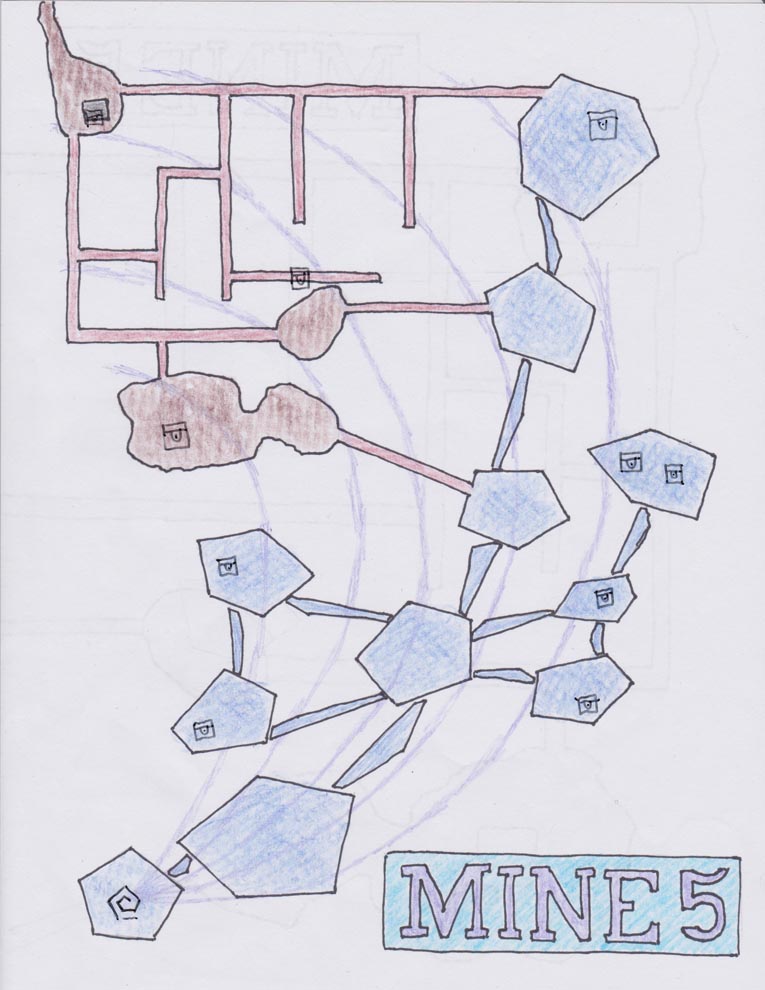
No matter how much Nintendo tries to break things up with world maps, quests, NPCs, and unskippable cutscenes, Zelda is a game of dungeons. The whole series is based on a structure of explore -> learn -> find dungeon -> get item -> fight boss -> acquire jewelry/girl/plot coupon. It’s only right that we start by talking about the dungeons in the campaign. A while has passed since I posted the first round of maps. Here’s the rest:


Some of those fonts were hard to draw.

Recall that the first half of the campaign was cave -> open-air forest -> maze of rotating rooms, all alike -> town -> giant pool of poison -> jail. The second half was grid of catacombs -> abandoned mineshaft -> beanstalk -> an ordinary house, nothing to see here, move along -> looping ice caverns -> legit palace. I didn’t escalate every time, but I did get the upward trend in complexity I wanted.

Dungeon eight has two maps because I wanted to subvert Zelda’s “the map is always right” trope. The players got the first map early in the dungeon, and they were so happy getting it because it meant they wouldn’t get lost in the twisty passageways. They immediately set out to explore the whole place, figuring out where the boss was and such. Only after a few dead ends did they conclude that the map represented an outdated layout of the mine, and the real map expanded the dungeon and explained what those purple veins of ore actually were.

By this point in the campaign, each dungeon was one overarching puzzle that often leveraged the dungeon item. The catacombs had a single beam of light the players needed to reflect through lenses to focus it until it could destroy walls of necrotic energy. The mineshaft’s history and current status slowly become clear over time. The beanstalks had leaves that could rise and lower based on proper gardening care. The manor only allowed travel through one color of door at a time. The ice maze forced the players to spell out the names of NPCs before they could get anywhere. The palace had a hard 24-hour time limit and patrolling guards so the players had to balance speed, stealth, exploration, puzzles, combat, and rest. Interestingly the difficulty of each puzzle was inversely proportionate to how complex the zone around the dungeon was. I’m going to pretend that was intentional.

I do think I didn’t design these quite as well as I could have, and I don’t know how much of that I can blame on the tabletop setting. I erred on the side of giving the players freedom to explore, so I lost some control over my pacing. I wanted the players to discover an unsolvable problem, leave it to explore elsewhere, discover a solution to that problem, then go back and solve it. For example, Link might see a cliff too high to scale, find the hookshot, then go back and grapple to the top of the cliff. But in D&D players have a half-dozen other ways to get up a twenty-foot wall, and there’s more than one player. The Deku Leaf is a great way to let Link glide from one place to another, but only after the players got it did I realize only one character could use it at a time. They ended up hanging from each other’s knees while the strongest character (who was also the worst at flying) took control. If I did the campaign over, I’d either scrap any items that don’t work for a group or take the Four Swords route and distribute identical, less-powerful items to each character. But I didn’t, so the process of exploring a dungeon was less satisfying that it could have been.

I did like how each monster and boss (and most of the puzzles) made sense narratively within a dungeon’s story. There wasn’t much in the way of “this conveyor-belt moth is the boss of an underground dungeon made of skulls where you got the fire rod, because shut up”. It was more “this lightning elemental is the boss of this beanstalk because you’re very high up and the campaign boss who controls weather has it in for you”. My players were willing to accept any hand-waving I did when I let a fun combat override a sensible world history, but I like to think I did pretty well.

I don’t know how much more level design like this I’m going to do. These days we don’t do many campaigns where we have proper dungeon explorations, so it’s a muscle I don’t flex as much as I did here. I think if I was to get deeper into this I’d break out software and try to give the maps a sleeker look with more character. Maybe I’ll do some rough dungeons with blank keys and post them here for readers to steal at will. Most of what I find online are black and white maps with an old-school, hand-drawn aesthetic. That’s great, but sometimes I want something that doesn’t look like its heyday was twenty years ago.

…the Zelda campaign itself notwithstanding.

Posted in Campaigns, DMing | Tagged , | Comments Off on Campaign Report – Zelda Maps 2

#RPGaDAY 2016 Day 31

What is the best piece of advice you were ever given for your game of choice?

I don’t really remember what gaming advice I’ve been given, what advice I’ve adapted to gaming from other sources, and what I’ve determined on my own. I can remember several “aha” moments in my gaming career, like when I first realized DMing was something I could do or when I learned about player agency, but most of those qualify more as events than advice. A lot of the guidance I can quote is something I already knew but phrased in a way I hadn’t considered. For example, “retreat to the intellectual safety of combat” is an idiosyncratic shorthand for “fights, with their clear goals and limited tactical options, provide a spike in session pacing to soothe players stressing over the ambiguity of navigating diplomacy, mysteries, or other freeform encounters”. It’s good advice, but it’s not superlative and it’s most notable for its pith.

I think the best advice I’ve ever gotten for gaming is the best advice I’ve ever gotten in general: communicate. If you want to know what your players think of something, ask them. If you want your DM to give you something, tell her. If you want the rest of the party to treat your character a certain way, say so. Nobody knows what anybody else is thinking; we’re all going on our best guesses based on observation and reasoning, and sometimes those guesses are wrong. You need to say what’s on your mind if you want other people to know it, and if you have to ask what somebody else thinks if they’re not going to tell you on their own. Communication is the principle behind cooperative design, session zero, this blog itself, and the very concept of cooperative tabletop play. If players and DMs don’t talk to each other, you don’t have a game at all.

Posted in Events | Tagged | Comments Off on #RPGaDAY 2016 Day 31

#RPGaDAY 2016 Day 30

Describe the ideal game room if your budget were unlimited.

We’re actually in the process of creating our own game room, so I’ve been mulling this over lately. Given a budget significantly higher than mine, I’d go for:

  • A table where much of the surface area is a display under glass, so I can show a battle map or pictures.
  • A projector and screen to display other pictures or the ever-handy Live GameScreen.
  • Speakers around the room for background audio.
  • Lighting via those new-fangled light bulbs that can change color. I don’t want the whole room to suddenly go red, but I’d like to tint things a little yellow in a desert or blue near water.
  • A dedicated gaming computer, or a place I can plug in a laptop, to control all of the above.
  • Six player chairs, with cushions and backs but no arms. I find that arms encourage a person to sit back, and I’d rather have players lean into the table.
  • One DM chair, as above but higher. I’m not very tall.
  • Power access in the table or floor, for laptops.
  • A small fridge for gaming drinks and anybody who brought lunch.
  • A bookcase for gaming books, instead of having them two floors away.
  • Minis, terrain, prop, and board game storage.
  • Carpet. No audible foot-tapping.
  • Appropriate wall decorations and posters. Physical props would be neat, but then I’d have to dust them.
  • And finally, because I know my players, coasters.
Posted in Events | Tagged | Comments Off on #RPGaDAY 2016 Day 30

#RPGaDAY 2016 Day 29

If you could host a game anywhere on Earth, where would that be?

My answer to this question is “the answer to tomorrow’s question”, but that’s a lame answer. I choose to believe this question came first to encourage us to answer as though tomorrow’s question didn’t exist. That makes for much more interesting answers than assuming the questions were not ordered well.

If I’m going to pick a location like this, I want it to be something that enhances the game and makes me happy; castles are great, but they’re not terribly comfortable and they really only help for verisimilitude if your campaign is happening in that exact castle. Instead I want to go the opposite route. I’ve always wanted to run something set twenty minutes into the future, with minor sci-fi trappings in a mostly modern game. I don’t want to do cyberpunk, just something in a present-day city where cyborgs or sentient AIs or biological experiments simmer just under the surface so players can discover them as they explore the setting. For that, I would want the game set in a city, in a modern office building or high-rise, with full-window walls, at night. City skylines are not only gorgeous, they give me that touch of sonder I want to impart to the players, where they look at the game, then look outside and think “this is all fictional, and nothing like this is happening to anybody down there…right?”

Posted in Events | Tagged | Comments Off on #RPGaDAY 2016 Day 29

#RPGaDAY 2016 Day 28

What film or novel would you be most surprised that a friend had not seen or read?

Nothing really surprises me about film or novel experience. It might be because I game in a college town, where many of my players didn’t grow up with the same media as I did because of our geographical, cultural, or chronological differences. I’ve had players who didn’t know Lord of the Rings was a book before it was a movie, or who didn’t know which jokes came from Monty Python and the Holy Grail, and most of them weren’t interested in correcting that. I’d be stunned if a player had never heard of them, but experiencing them as they are intended is another thing altogether. It helps that I tend not to read novels or watch movies myself; most of my references come from television, comics, and video games, so that’s what pops up in my campaigns.

If I have to pick something, I’ll pick The Avengers. It’s recent enough that my players aren’t too young for it, it’s popular enough that everybody’s had a chance to see it, and it’s relevant enough that it falls within the interests of pretty much anybody I know who games.

Posted in Events | Tagged | Comments Off on #RPGaDAY 2016 Day 28

#RPGaDAY 2016 Day 27

Describe the most unusual circumstance or location in which you have gamed.

A few years ago, my wife had the opportunity to take a short internship far from home. I could take my work with me as long as I had an Internet connection, so for a little more than five months we lived in a barn in central Florida. But the Internet where we lived was not up to par, so we made inquiries and found a business, associated with the internship, who graciously allowed me to use theirs. However, they really only had one place where I could set up in the relative privacy I needed to do what I did without getting in their way.

As such, I found myself gaming online for half a year from a storage closet, sandwiched between a shelf of home-jarred foodstuffs and enough items to cook them should a hurricane take out power for the better part of a month. I have never had an officemate as quiet and as creepy as a jar of meat two feet from my chair, unless you count the garden statue of a royal frog in the same room:

I don’t think anybody knew how it got there. It just was. Sitting there. Staring. All day. Every day of the week. For five months.

Around that time my players toppled a kingdom. Probably coincidence.

Posted in Events | Tagged | Comments Off on #RPGaDAY 2016 Day 27

#RPGaDAY 2016 Day 26

What hobbies go well with RPGs?

Anything that exposes you to ideas. I feel a little bad encouraging watching TV and playing video games over hobbies that involve craftsmanship, but craft hobbies don’t teach you ideas as much as they teach you very specific methods for expressing those ideas. Learning to paint minis will give you great minis to game with. Learning to follow and build stories will give you several campaigns’ worth of characters and plots you can use with pretty much any minis you want. From an investment/return perspective, I don’t see how there’s any comparison.

The trick is to do it actively instead of passively. Don’t just watch television; figure out how a show manages its emotional content based on how far it is into its season. Don’t just play video games; notice what kind of enemies they use and how they contribute to the rhythm of the game and the overall theme. Don’t just read books; focus on how authors introduce and build characters. When you understand how somebody puts something together, you also understand how to take it apart and do what you want with the pieces.

Posted in Events | Tagged | Comments Off on #RPGaDAY 2016 Day 26

#RPGaDAY 2016 Day 25

What makes for a good character?

Hoo boy.

I have strong opinions about what makes a good character, probably strong enough that I can’t do them justice in a post this small. Instead of a series of essays, I’m just going to put some requirements in bullet point format. Maybe in a while I’ll expand on them:

  • A good character needs to grow given sufficient time. If the only things that change between L1 and L20 are numbers, you don’t have a character, you have a build.
  • Every part of a good character works together. The character should feel like you say they feel, and their build should support that feeling, and you should play them with that feeling in mind.
  • A good character works with the group. Lone wolves are for novels, not cooperative tabletop gaming, and a grimdark ranger will not gel with a table of jokers.
  • A good character works with the setting and the campaign. They shouldn’t bring you out of the game by their mere existence, and they shouldn’t exist primarily to usurp or frustrate the DM.
  • A good character should be unique. They shouldn’t be the same build, personality, name, or miniature you use in every campaign, and they shouldn’t be an obvious bootleg of a pre-existing character.
  • A good character is fun. This is the most important part. You can have a one-note samurai Iron Man who constantly undermines the rest of the party, but if everybody thinks he’s hilarious they’ll probably remember that character more fondly than the inoffensive but boring cleric struggling with the family she left behind on her journey to retrieve the artifact her mentor stole. If you’re enjoying yourself and you’re helping everybody else enjoy themselves, that’s the point of the game.

This isn’t some scale I use to measure characters; I don’t compare each build to this list and decide a character who meets five points is better than a character who only meets three. If I did, I’d have several characters of my own who don’t qualify. But if I see a character and I don’t think they’re good, it’s probably because they’re missing more of these than I’d like.

Posted in Events | Tagged | Comments Off on #RPGaDAY 2016 Day 25

#RPGaDAY 2016 Day 24

What is the game you are most likely to give to others as a gift?

I feel bad giving people games I have or I want to play. There’s an implicit “we will do this together” in there, so I feel like I’m socially tying them to play the game with me lest they ignore the gift entirely. So the game I’m most likely to give is something I never want to play myself. Usually that’s because it’s designed for local multiplayer; in the last ten years I’ve played exactly five games with people in the same room, and three of those were one-offs. Other people don’t have this problem, so I don’t mind getting them games they can play with each other.

This does occasionally put me in the hilarious state of looking at a game and going “This looks fun. Do I have any friends who have friends? They can tell me stories about it.”

Posted in Events | Tagged | Comments Off on #RPGaDAY 2016 Day 24

#RPGaDAY 2016 Day 23

Share one of your best ‘Worst Luck’ stories.

I don’t have “worst luck” stories as much as I have a “worst luck” career. I’ve mentioned earlier this month how I have a handicap on rolling during character creation and how we have fast-resurrection mechanics to counteract how often I seem to die. Neither of these even touched on how well I roll as a DM; I’ve rolled an inordinate amount of 1s when I tried to show off a new monster and plenty of 20s when I tried to not kill a player. Heck, it even extends beyond gaming. My family would love to tell you about the time they were moving me cross-state, when I pulled off at a rest stop for a quick drink, found a vending machine that ate every quarter I had, then got back on the highway going the wrong way for fifteen minutes. To this day I don’t know how I found a way to do that from a rest stop with only one exit.

So instead of trying to pick a superlative out of that pile, I’ll just refer you back to the time I botched a roll to dial a phone for its perfect blend of bad luck, comedy, and memorability.

Posted in Events | Tagged | Comments Off on #RPGaDAY 2016 Day 23